
Drive-by-Wire Actuators and High Vibration Applications
Case Study: EFI Hardware DBW Actuator and Kawasaki ZX10R Engine
Drive-by-wire actuators are increasingly being used in motorsport, engine conversions, custom builds and applications where conventional mechanical throttle control is impractical.
While actuator selection, throttle spring rates, linkage geometry and electrical supply are all important considerations, the installation environment itself can have a significant impact on reliable operation.
A recent customer application highlighted an important considering when installing DBW actuators on high-revving motorcycle engines: vibration isolation.
This case study follows the use of EFI Hardware's DBW Actuator installation in Derek's modified AWD Hybrid Nissan Leaf, where a relatively simple mounting modification resolved an intermittent high-RPM throttle control issue.
The Vehicle and Engine
The customer, Derek, who is no stranger to overcoming engineering challenges, has developed a unique AWD Hybrid Nissan Leaf incorporating two different drive systems. The front wheels retain the electric vehicle drivetrain, while a motorcycle engine conversion provides rear-wheel drive. The rear-mounted engine is a 2008 Kawasaki ZX-10R 998cc inline-four superbike engine, utilizing its original four 47mm individual throttle bodies, an ECUMaster EMU Black and our EFI Hardware Drive by Wire Actuator.
The Problem: Actuator at 98% Saturation at High RPM
Derek initially contacted us after experiencing an unusual throttle control issue.
During high-RPM operation, the throttle would initially achieve 100% opening but progressively close as engine speed increased, particularly around 12,500RPM.
Despite the throttle closing, the ECUMaster EMU Black continued commanding the actuator to maintain its requested 100% throttle position.
A supplied data log revealed:
- DBW Target: 100%
- Actual TPS: Progressively falling towards approximately 35%
- DBW Output Duty Cycle: Approximately 98-100%
- Engine Speed: 10,500 - 13,300 RPM during the recorded acceleration run.
The ECU was effectively commanding the maximum motor output without being able to maintain the requested throttle position.
This initially suggested that the actuator was reaching its available torque limit.
The Investigation
We reviewed the supplied ECUMaster datalog and discussed several potential causes with Derek.
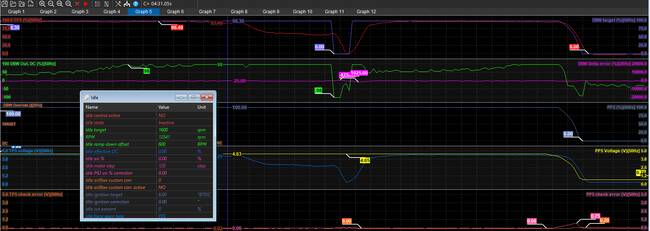
Data log with TPS falling and DBW DC saturating at 98%
Electrical connections and vibrations - One known consideration with DBW installations is vibration affecting the electrical connection at the standard Bosch connector. We have previously encountered intermittent power connection issues in high-vibration environments however the data log did not show obvious electrical dropouts or interruptions in the motor drive or throttle position signals.
Mechanical loading and return springs
The Kawasaki throttle bodies retained their original return spring arrangement, although one of the factory return springs had already been disconnected. The remaining spring was suspected of imposing excessive mechanical load on the actuator. The use of lightweight return springs and low-stiction linkages to minimise required actuator torque was discussed.
Electrical drive capacity
The ECUMaster EMU Black was driving the actuator directly through its internal H-bridge. Consideration was made as to whether the ECU's available current, actuator supply voltage or motor thermal characteristics could be contributing to the problem. An external high-current motor driver was discussed but increasing the available current was not recommended without having first established the actual cause of the issue.
Controlled testing
We recommended several tests to isolate the mechanical and electrical components to establish a few key details:
Confirm that commanding 100% WOT (wide-open-throttle) resulted in the butterflies reaching their fully open mechanical position.
Disconnect the actuator linkage and independently measure the force required to operate the throttle assembly.
Operate the actuator independently, without the throttle assembly connected, and compare its behavior through the ECU data log.
These tests were intended to establish whether the issue was related to mechanical loading or actuator operation.
The Discovery: Rigid Mounting and Engine Vibration
After further investigation, Derek found similar stories of Bosch actuator motors suffering from high engine vibration, particularly in cases where engines are hard-mounted. Not something typically seen with the every-day consumer. Although internal motor components were not inspected and the precise internal failure mechanism has not been verified in this case, the theory is the internal motor brushes resonate causing bouncing, ultimately losing contact with the commutator and forcing the ECU to command maximum DC to maintain target. In this particular case, the resonance was worst at 12,500RPM.
The Solution: Actuator Isolation Mounts
Wanting to test the theory, Derek installed rubber isolation mounts between the actuator and the engine. The isolation mounts reduce the direct transmission of engine vibrations and harmonics into the actuator housing and motor. The results were significant.
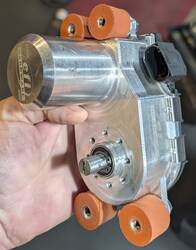
Isolation mounts installed
Following the installation, the actuator successfully maintained full throttle. The previous high-RPM throttle position drop-off was eliminated. The engine was able to reach redline without issue, and the DBW output duty cycle reduced from 98% down to an expected 25%. The before and after results strongly indicated that vibration was transmitted through the original mounting arrangement and causing the internal issues.
A relatively simple mounting modification resolved an issue that initially appeared to be an issue of two other unrelated factors.
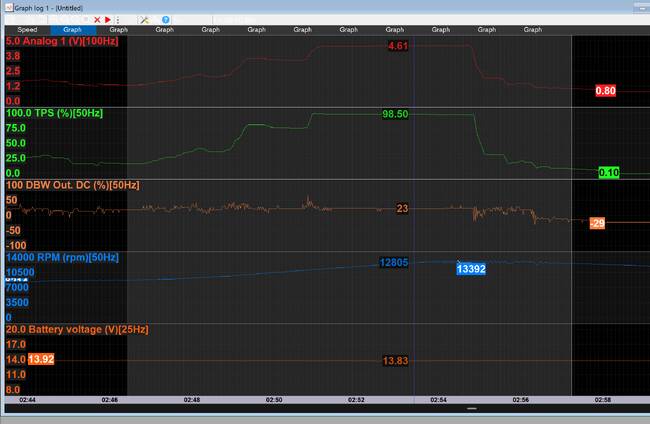
Data log with a clean run post isolation mounts installed
Conclusion
Derek's AWD hybrid Nissan Leaf is an excellent example of the unusual applications in which modern drive by wire technology is being utilized. What initially appeared to be an actuator limitation turned out to be associated with the actuators mounting environment.
By introducing the vibration isolation mounts, the high-RPM throttle position issue was rectified without having to change the actuator, increase motor current or modify ECU strategy.
We thank Derek for sharing his findings and allowing us to document this application as a real-world technical case study.
Catch the Hybrid Leaf in Action!
You can read more on this unique build here, but before you do, see it cutting some laps at Sonoma Raceway below.
Technical note: The suspected brush/commutator resonance in this case has not been independently verified. The improvement following the installation of vibration isolation mounts is based on the customer's reported testing and results.
GOOGLE CUSTOMER FEEDBACK
⭐⭐⭐⭐⭐
We ship anywhere in Australia and World Wide
Call us now: +61 3 9873 5400 (Mon - Fri 8:00 - 4:30)

DBHM Custodial Pty Ltd
Trading as EFI Hardware
A.B.N. 48 695 431 120

